 Danish
 Icelandic

With sustainability as a guide
Verkís’ sustainability
Verkís’ mission is to create value and support the development of society and its infrastructure through expert advice and design. With a clear vision for the future, Verkís has developed a strategic focus on customers, staff, and society. The company places strong emphasis on sustainability, service, and human resources policies, all of which align with the United Nations’ global goals and the UN Global Compact.
Verkís takes great pride in ensuring that its activities benefit everyone. We encourage responsibility in our work, guided by sustainability to positively impact society and the environment. Our staff is dedicated to finding solutions and delivering services that meet the key criteria for sustainable development.
Sustainability at Verkís
Main findings of the 2025 sustainability report
Verkís’s total emission in 2025
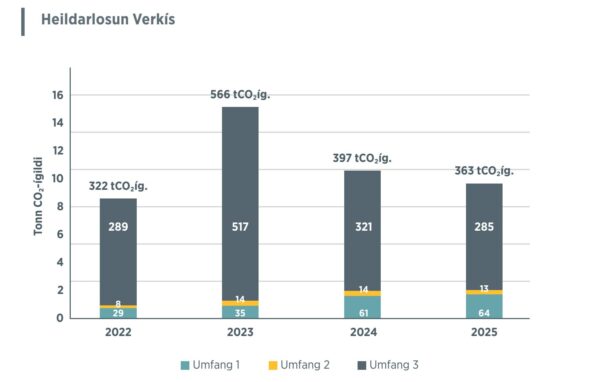
Greenhouse gas (GHG) emissions from Verkís’ operations in 2025 totalled 362 tonnes of CO₂ equivalent (CO₂e), a 9% decrease compared to 2024.
Verkís’ carbon footprint comprises both direct and indirect GHG emissions arising from its operations. Direct emissions originate from sources owned or controlled by the company, primarily the use of fossil fuels in company vehicles. Indirect emissions arise from purchased energy, the supply chain, and the use of products and services. These indirect emissions constitute the largest share of the company’s overall carbon footprint.
Main findings of the 2025 sustainability report
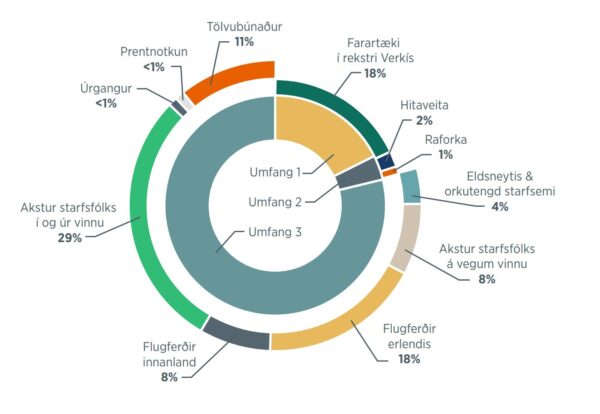
Origin of emissions 2025
Total Scope 1 and Scope 2 emissions in 2025 were 78.6 tonnes of CO₂ equivalent (CO₂e), a 2% increase from 2024. The increase is primarily attributable to higher fossil fuel use in Verkís’ company vehicles. Environmentally friendly vehicles, including electric and hybrid vehicles, account for 58% of the company’s vehicle fleet.
Total Scope 3 emissions in 2025 were 285 tonnes of CO₂ equivalent (CO₂e), representing an 11% reduction compared to 2024. The main driver of this decrease was a substantial reduction in the carbon footprint associated with computer equipment purchases, which declined by 35% year-on-year. Employee business travel remains the largest contributor to Verkís’ overall carbon footprint, followed by employee commuting.