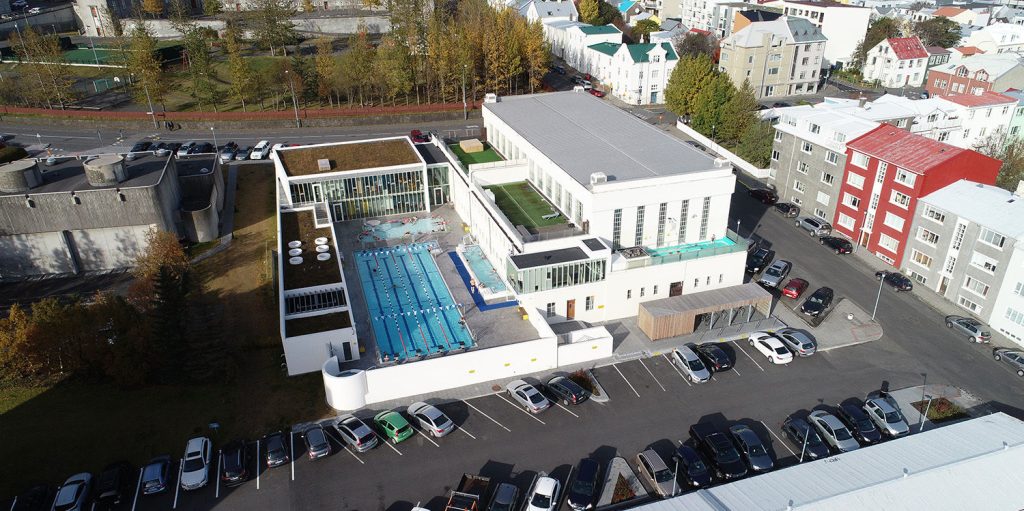
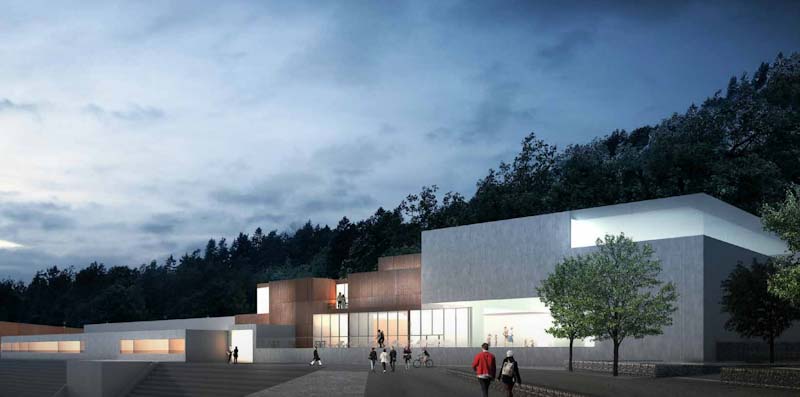
It has an estimated capacity of 400 people in the pool at the same time. Seating for spectators are situated in the main swimming pool hall.
FutureBuilt in Norway has chosen the Holmen swimming pool in Asker as one of 50 pilot projects as the swimming pool meets all the conditions for an environmentally friendly construction. Low carbon energy source plays a key role for the building with the energy being extracted from 15 geothermal wells near the house as well as utilizing solar energy for electricity generation. The FutureBuilt Partnership aims to establish so-called carbon neutral communities using state-of-the-art architecture by supporting 50 pilot projects that aim to reduce greenhouse gas emissions by 50% in the fields of traffic, energy and materials use.
The project was a collaboration with Arkís architects who oversaw architectural design, landscape architecture and interior design.
Additionally, many other environmentally-friendly solutions were used in the construction, not least in the selection of building materials, the use of LED lighting, energy-saving equipment, energy recovery etc. The house is extremely well insulated and almost air tight, and glazed areas are minimized. When the pools are not in use, the adjustable bottoms lift to the top to minimize energy loss. These measures aim at minimizing energy requirements, thus creating the possibility that 50% of the energy demand can be met on site.
50% of the energy that the swimming pool will use must be obtained on site with the above-mentioned heat pumps, solar batteries and solar panels. It is also worth noting that the solar collectors in the parking lot can also be used during the summer to return energy to the geothermal wells, so they do not cool down too much improving the sustainability of the wells. They can also be used for snow melting in winter. When the energy output from the swimming pool is greater than is required for its operation, the electricity is sold on the electrical utility´s electrical system.
Verkís was responsible for project management, cost estimates, all engineering design, transportation systems, geotechnical engineering, management of building permit licensing, preparation of tender documents, construction time consultation, and preparation of the operating manual. The project is based on BIM methodology.
The Challenge
Reykjavík Energy owns the Hellisheidi geothermal power plant, a combined heat and power plant located about 20 km from Reykjavík in south-west Iceland. The area is one of Iceland’s most active high enthalpy areas. A new area, at Gráuhnúkar, is being investigated for steam and fluid extraction. The purpose of the plants is to meet increased demand for electricity for industrial and domestic use and for hot water for heating. The 303 MWe geothermal power plant in Hellisheiði, Iceland, was commissioned in 5 stages during the years 2006-2011. The first stage was completed in 2006 with two high pressure geothermal turbines of 45 MWe capacity each. The second stage was completed in 2007 with one low pressure geothermal turbine of 33 MWe capacity. The third stage was completed in 2008 with two additional high pressure geothermal turbines, 45 MWe each.
In 2010 a heating plant for hot water generation was added to the plant, intended for district heating. The heat output of the first stage is 133 MWth and two further 133 MWth stages are to follow later. At the same time the Hellisheiði hot water main was put into service. The main is a 19,5 km long pipeline, 0,9-1,0 m in diameter, that carries hot water to Reykjavík. In 2011 the 5th stage of the plant was finished, which includes two new 45 MWe high pressure geothermal turbines, similar to the former turbines, situated in a new power house in Sleggjubeinsdalur.
The plant utilizes 500 kg/s of 180°C geothermal steam for electrical generation. The hot fluid is extracted from 30 wells, 2.000 – 3.000 m deep, and is led through steam and mist separators before entering the turbines. The high pressure steam gathering system operates at 9 bara pressure. The low pressure steam is generated with flashing of brine water from the steam separators at a pressure of 2 bara. The generating units are of single flow, single flash type with axial exhaust. Cooling is achieved through wet cooling towers of the counter flow type.
The main components of the electrical system for each unit consist of a 50 MVA generator, 50 MVA step-up transformer to 220 kV transmission voltage, an 11/11 kV transformer for connection to the 11 kV station service system and two 11/0,4 kV transformers for station service. The generating units, as well as the 11 kV and 0,4 kV distribution boards, are monitored and controlled by the state of the art control- and protection equipment.
Our Solution
Reykjavík Energy owns the Hellisheidi geothermal power plant, a combined heat and power plant located about 20 km from Reykjavík in south-west Iceland. The area is one of Iceland’s most active high enthalpy areas. A new area, at Gráuhnúkar, is being investigated for steam and fluid extraction. The purpose of the plants is to meet increased demand for electricity for industrial and domestic use and for hot water for heating. The 303 MWe geothermal power plant in Hellisheiði, Iceland, was commissioned in 5 stages during the years 2006-2011. The first stage was completed in 2006 with two high pressure geothermal turbines of 45 MWe capacity each. The second stage was completed in 2007 with one low pressure geothermal turbine of 33 MWe capacity. The third stage was completed in 2008 with two additional high pressure geothermal turbines, 45 MWe each.
In 2010 a heating plant for hot water generation was added to the plant, intended for district heating. The heat output of the first stage is 133 MWth and two further 133 MWth stages are to follow later. At the same time the Hellisheiði hot water main was put into service. The main is a 19,5 km long pipeline, 0,9-1,0 m in diameter, that carries hot water to Reykjavík. In 2011 the 5th stage of the plant was finished, which includes two new 45 MWe high pressure geothermal turbines, similar to the former turbines, situated in a new power house in Sleggjubeinsdalur.
The plant utilizes 500 kg/s of 180°C geothermal steam for electrical generation. The hot fluid is extracted from 30 wells, 2.000 – 3.000 m deep, and is led through steam and mist separators before entering the turbines. The high pressure steam gathering system operates at 9 bara pressure. The low pressure steam is generated with flashing of brine water from the steam separators at a pressure of 2 bara. The generating units are of single flow, single flash type with axial exhaust. Cooling is achieved through wet cooling towers of the counter flow type.
The main components of the electrical system for each unit consist of a 50 MVA generator, 50 MVA step-up transformer to 220 kV transmission voltage, an 11/11 kV transformer for connection to the 11 kV station service system and two 11/0,4 kV transformers for station service. The generating units, as well as the 11 kV and 0,4 kV distribution boards, are monitored and controlled by the state of the art control- and protection equipment.
The Result
Reykjavík Energy owns the Hellisheidi geothermal power plant, a combined heat and power plant located about 20 km from Reykjavík in south-west Iceland. The area is one of Iceland’s most active high enthalpy areas. A new area, at Gráuhnúkar, is being investigated for steam and fluid extraction. The purpose of the plants is to meet increased demand for electricity for industrial and domestic use and for hot water for heating. The 303 MWe geothermal power plant in Hellisheiði, Iceland, was commissioned in 5 stages during the years 2006-2011. The first stage was completed in 2006 with two high pressure geothermal turbines of 45 MWe capacity each. The second stage was completed in 2007 with one low pressure geothermal turbine of 33 MWe capacity. The third stage was completed in 2008 with two additional high pressure geothermal turbines, 45 MWe each.
In 2010 a heating plant for hot water generation was added to the plant, intended for district heating. The heat output of the first stage is 133 MWth and two further 133 MWth stages are to follow later. At the same time the Hellisheiði hot water main was put into service. The main is a 19,5 km long pipeline, 0,9-1,0 m in diameter, that carries hot water to Reykjavík. In 2011 the 5th stage of the plant was finished, which includes two new 45 MWe high pressure geothermal turbines, similar to the former turbines, situated in a new power house in Sleggjubeinsdalur.
The plant utilizes 500 kg/s of 180°C geothermal steam for electrical generation. The hot fluid is extracted from 30 wells, 2.000 – 3.000 m deep, and is led through steam and mist separators before entering the turbines. The high pressure steam gathering system operates at 9 bara pressure. The low pressure steam is generated with flashing of brine water from the steam separators at a pressure of 2 bara. The generating units are of single flow, single flash type with axial exhaust. Cooling is achieved through wet cooling towers of the counter flow type.
The main components of the electrical system for each unit consist of a 50 MVA generator, 50 MVA step-up transformer to 220 kV transmission voltage, an 11/11 kV transformer for connection to the 11 kV station service system and two 11/0,4 kV transformers for station service. The generating units, as well as the 11 kV and 0,4 kV distribution boards, are monitored and controlled by the state of the art control- and protection equipment.