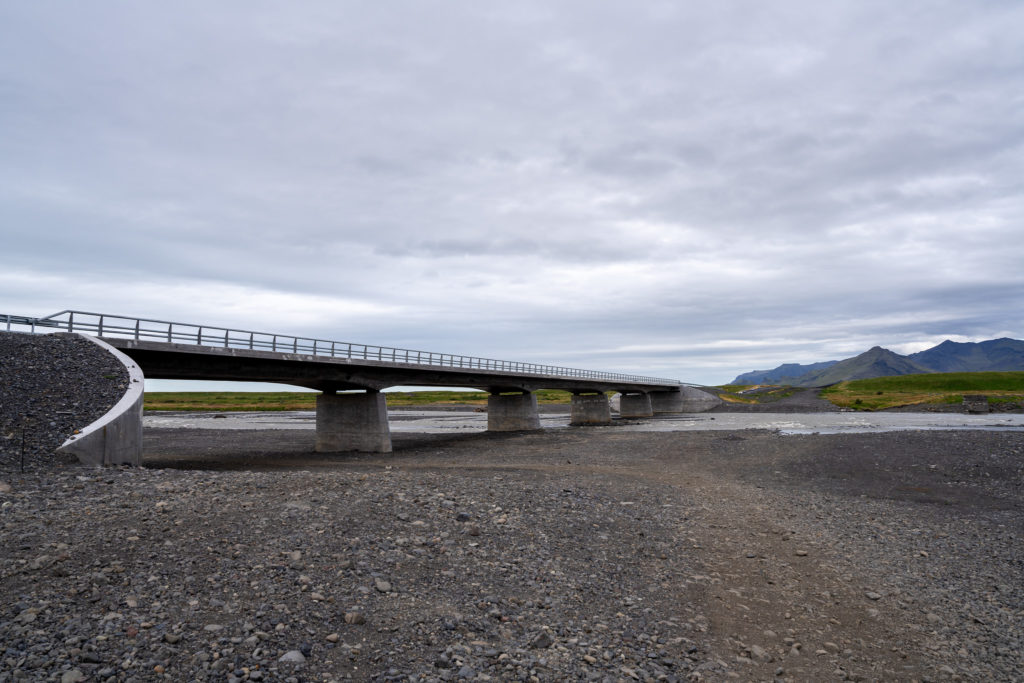
Verkís provided construction supervision and project oversight for the 2.5-kilometre section, which was designed to support the future development of a 2+2 lane highway while initially operating as a 2+1 road with separated traffic lanes.
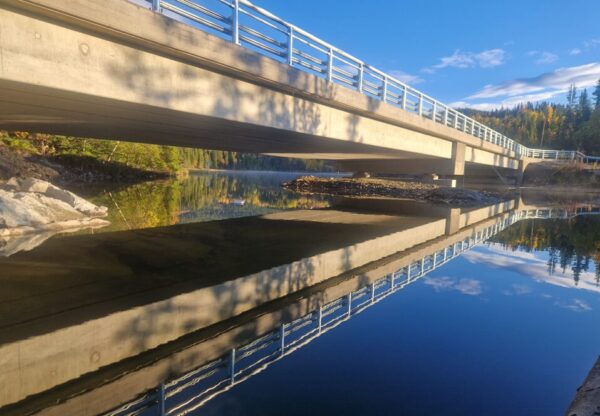
A major challenge of the project was the bridge widening itself. The Varmá River and its surroundings are listed on Iceland’s Natural Heritage Register and support important populations of sea trout, salmon, flounder, eels, and diverse aquatic ecosystems. To minimise environmental impacts, all work in and around the river was restricted to a three-month construction window outside sensitive migration and spawning periods.
The existing bridge, originally constructed in 1970, was widened by 13 metres while maintaining the appearance and structural principles of the original reinforced concrete structure. Challenging weather conditions, frequent flooding, and a highly restricted construction schedule required innovative engineering solutions. To avoid disturbance to the riverbed after the permitted construction period had ended, the project team redesigned the bridge deck support system using steel beams spanning between the bridge walls, eliminating the need for temporary supports within the river channel.
The project demonstrates how careful planning, environmental stewardship, and engineering innovation can successfully deliver critical transport infrastructure while protecting sensitive natural environments.
The Challenge
Reykjavík Energy owns the Hellisheidi geothermal power plant, a combined heat and power plant located about 20 km from Reykjavík in south-west Iceland. The area is one of Iceland’s most active high enthalpy areas. A new area, at Gráuhnúkar, is being investigated for steam and fluid extraction. The purpose of the plants is to meet increased demand for electricity for industrial and domestic use and for hot water for heating. The 303 MWe geothermal power plant in Hellisheiði, Iceland, was commissioned in 5 stages during the years 2006-2011. The first stage was completed in 2006 with two high pressure geothermal turbines of 45 MWe capacity each. The second stage was completed in 2007 with one low pressure geothermal turbine of 33 MWe capacity. The third stage was completed in 2008 with two additional high pressure geothermal turbines, 45 MWe each.
In 2010 a heating plant for hot water generation was added to the plant, intended for district heating. The heat output of the first stage is 133 MWth and two further 133 MWth stages are to follow later. At the same time the Hellisheiði hot water main was put into service. The main is a 19,5 km long pipeline, 0,9-1,0 m in diameter, that carries hot water to Reykjavík. In 2011 the 5th stage of the plant was finished, which includes two new 45 MWe high pressure geothermal turbines, similar to the former turbines, situated in a new power house in Sleggjubeinsdalur.
The plant utilizes 500 kg/s of 180°C geothermal steam for electrical generation. The hot fluid is extracted from 30 wells, 2.000 – 3.000 m deep, and is led through steam and mist separators before entering the turbines. The high pressure steam gathering system operates at 9 bara pressure. The low pressure steam is generated with flashing of brine water from the steam separators at a pressure of 2 bara. The generating units are of single flow, single flash type with axial exhaust. Cooling is achieved through wet cooling towers of the counter flow type.
The main components of the electrical system for each unit consist of a 50 MVA generator, 50 MVA step-up transformer to 220 kV transmission voltage, an 11/11 kV transformer for connection to the 11 kV station service system and two 11/0,4 kV transformers for station service. The generating units, as well as the 11 kV and 0,4 kV distribution boards, are monitored and controlled by the state of the art control- and protection equipment.
Our Solution
Reykjavík Energy owns the Hellisheidi geothermal power plant, a combined heat and power plant located about 20 km from Reykjavík in south-west Iceland. The area is one of Iceland’s most active high enthalpy areas. A new area, at Gráuhnúkar, is being investigated for steam and fluid extraction. The purpose of the plants is to meet increased demand for electricity for industrial and domestic use and for hot water for heating. The 303 MWe geothermal power plant in Hellisheiði, Iceland, was commissioned in 5 stages during the years 2006-2011. The first stage was completed in 2006 with two high pressure geothermal turbines of 45 MWe capacity each. The second stage was completed in 2007 with one low pressure geothermal turbine of 33 MWe capacity. The third stage was completed in 2008 with two additional high pressure geothermal turbines, 45 MWe each.
In 2010 a heating plant for hot water generation was added to the plant, intended for district heating. The heat output of the first stage is 133 MWth and two further 133 MWth stages are to follow later. At the same time the Hellisheiði hot water main was put into service. The main is a 19,5 km long pipeline, 0,9-1,0 m in diameter, that carries hot water to Reykjavík. In 2011 the 5th stage of the plant was finished, which includes two new 45 MWe high pressure geothermal turbines, similar to the former turbines, situated in a new power house in Sleggjubeinsdalur.
The plant utilizes 500 kg/s of 180°C geothermal steam for electrical generation. The hot fluid is extracted from 30 wells, 2.000 – 3.000 m deep, and is led through steam and mist separators before entering the turbines. The high pressure steam gathering system operates at 9 bara pressure. The low pressure steam is generated with flashing of brine water from the steam separators at a pressure of 2 bara. The generating units are of single flow, single flash type with axial exhaust. Cooling is achieved through wet cooling towers of the counter flow type.
The main components of the electrical system for each unit consist of a 50 MVA generator, 50 MVA step-up transformer to 220 kV transmission voltage, an 11/11 kV transformer for connection to the 11 kV station service system and two 11/0,4 kV transformers for station service. The generating units, as well as the 11 kV and 0,4 kV distribution boards, are monitored and controlled by the state of the art control- and protection equipment.
The Result
Reykjavík Energy owns the Hellisheidi geothermal power plant, a combined heat and power plant located about 20 km from Reykjavík in south-west Iceland. The area is one of Iceland’s most active high enthalpy areas. A new area, at Gráuhnúkar, is being investigated for steam and fluid extraction. The purpose of the plants is to meet increased demand for electricity for industrial and domestic use and for hot water for heating. The 303 MWe geothermal power plant in Hellisheiði, Iceland, was commissioned in 5 stages during the years 2006-2011. The first stage was completed in 2006 with two high pressure geothermal turbines of 45 MWe capacity each. The second stage was completed in 2007 with one low pressure geothermal turbine of 33 MWe capacity. The third stage was completed in 2008 with two additional high pressure geothermal turbines, 45 MWe each.
In 2010 a heating plant for hot water generation was added to the plant, intended for district heating. The heat output of the first stage is 133 MWth and two further 133 MWth stages are to follow later. At the same time the Hellisheiði hot water main was put into service. The main is a 19,5 km long pipeline, 0,9-1,0 m in diameter, that carries hot water to Reykjavík. In 2011 the 5th stage of the plant was finished, which includes two new 45 MWe high pressure geothermal turbines, similar to the former turbines, situated in a new power house in Sleggjubeinsdalur.
The plant utilizes 500 kg/s of 180°C geothermal steam for electrical generation. The hot fluid is extracted from 30 wells, 2.000 – 3.000 m deep, and is led through steam and mist separators before entering the turbines. The high pressure steam gathering system operates at 9 bara pressure. The low pressure steam is generated with flashing of brine water from the steam separators at a pressure of 2 bara. The generating units are of single flow, single flash type with axial exhaust. Cooling is achieved through wet cooling towers of the counter flow type.
The main components of the electrical system for each unit consist of a 50 MVA generator, 50 MVA step-up transformer to 220 kV transmission voltage, an 11/11 kV transformer for connection to the 11 kV station service system and two 11/0,4 kV transformers for station service. The generating units, as well as the 11 kV and 0,4 kV distribution boards, are monitored and controlled by the state of the art control- and protection equipment.